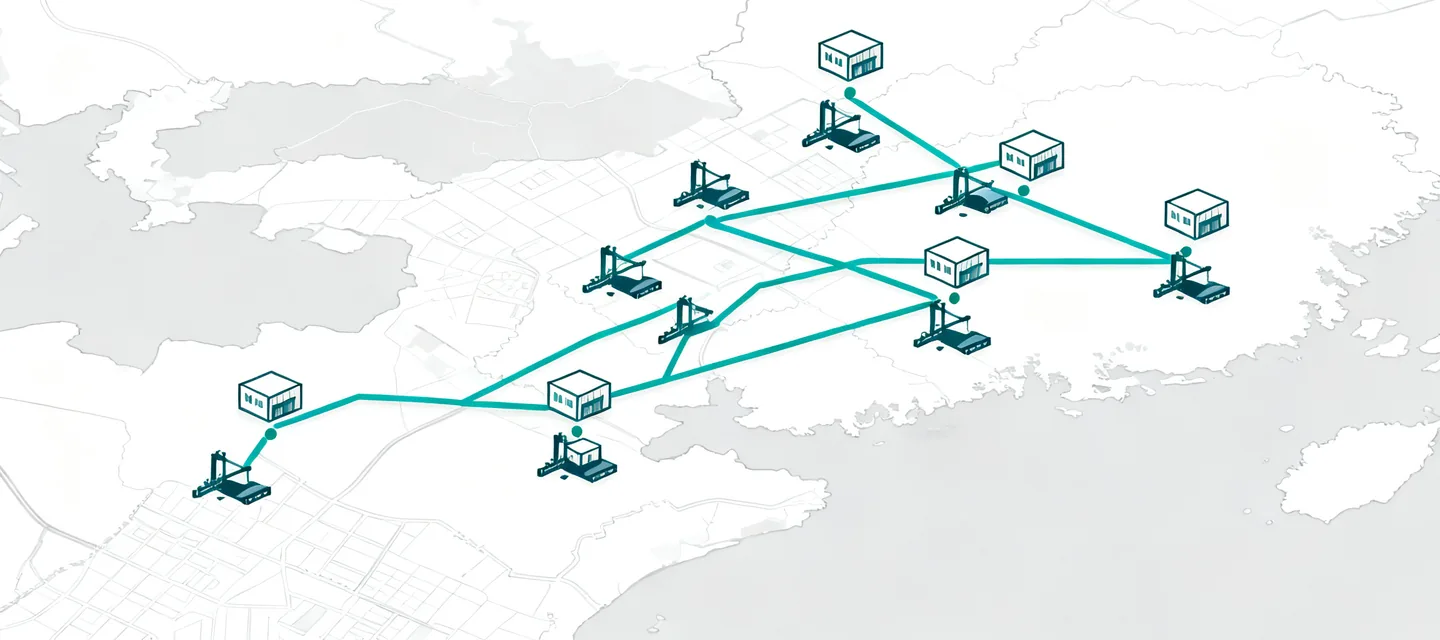
North America distribution and manufacturing corridors
Coastal fulfillment, inland food staging and manufacturing logistics share dock-to-staging pressure but diverge on temperature, trailer mix and pedestrian density. Hikrobot evaluations in this region start with measured aisle width in mm, charging maps and peak windows tied to carrier cutoffs rather than average daily moves. Planning-range discovery examples (not performance claims): 1–4 lines/order, peak factor 1.6–2.8× over 90–180 min, induction buffer occupancy capped before mission release.
West Coast e-commerce
Promotion waves, high SKU depth and mixed tote/pallet handoffs require traffic priority honesty and clear recovery paths when pack stations back up. Order lines/hour claims stay incomplete without SKU velocity bands, buffer occupancy and exception recovery minutes.
Central manufacturing
Takt-linked kit and pallet feeding needs interface cycle times in seconds that keep PLC and WES ownership unambiguous during shift peaks. Responsibility boundary: WMS owns kit intent; WCS/WES owns release; FMS owns traffic; PLC owns interlocks for FAT/SAT.
European grocery and ambient multi-temperature networks
Store cutoffs, chilled door windows and roll-cage traffic rewrite fleet selection faster than nameplate capacity. Hikrobot projects document temperature dwell, dock turnaround and shared-aisle rules before comparing AGV loops and AMR fleets.
Grocery DC clusters
Case and tote mixes force traffic priority that protects chilled dwell without inventing parallel fleets for every SKU band.
Urban staging hubs
Tight turning envelopes and mixed pedestrian corridors demand measured clearances and written intervention points.
Asia Pacific dense storage and multi-client sites
Variable client profiles and heterogeneous load units make average utilization a poor sizing tool. Hikrobot RFQs separate client-driven peaks, floor quality and interface ownership so expansion phases do not freeze tomorrow's aisle geometry.
Dense reserve storage
Selectivity, fire access and replenishment paths stay visible when mission density and recovery time are discussed together. Cube gains must still preserve aisle clear width in mm and a written expansion boundary for additional destinations or chargers.
Multi-client operations
Heterogeneous totes and pallets need acceptance protocols that name transaction definitions per client wave, rated load in kg with mm dimensions and system availability % at subsystem versus end-to-end boundaries.