Project services

Hikrobot services from fleet question to accepted handover

Warehouse robotics succeeds when equipment, WMS, WCS, PLC, fleet management and operations share one definition of normal flow and one method for recovering abnormal flow. Hikrobot project services organize those decisions into reviewable inputs, named responsibilities and test evidence.

Engagement begins with facts already available to the warehouse team: load units, origin-destination demand, peak windows, aisle geometry, existing host systems and maintenance access. Missing facts remain visible assumptions until measured or approved.

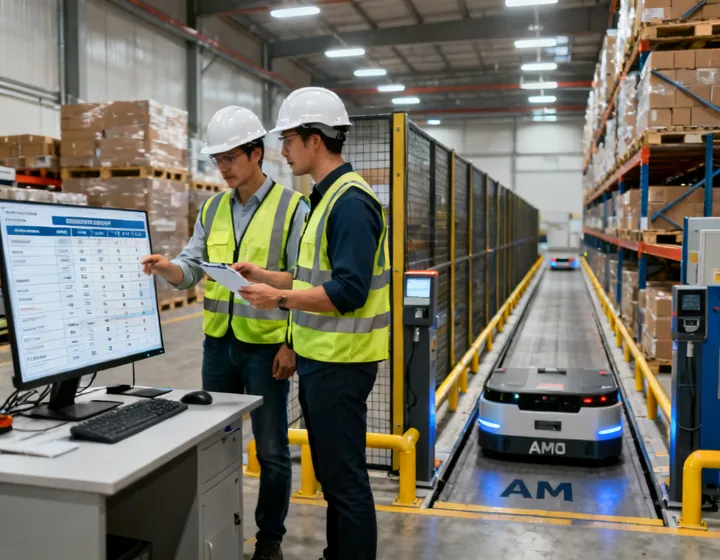
Engineers reviewing fleet responsibility matrix beside AMR aisle
Work packages

Scope the decisions that control delivery risk

01

Flow and throughput study

Translate material moves into demand by route, time window, buffer rule and replenishment competition. Separate average workload from peak workload and state what happens when a lane, station or host message becomes unavailable.

02

Controls responsibility matrix

Assign mission creation, inventory confirmation, equipment interlocks, alarms, retries and operator actions across WMS, WCS, WES, PLC and fleet-management layers. Document OPC UA or fieldbus handshakes, interface cycle time in seconds, and who owns acknowledgement, timeout and escalate paths. Target system availability (for example 95% or 98% end-to-end) must name the measurement window before it becomes a service claim.

03

Phased cutover planning

Protect live fulfillment with controlled zones, fallback states, commissioning windows and rollback criteria. Existing material flow stays visible, including temporary manual bypass and the point at which a new control layer assumes authority.

04

FAT, SAT and serviceability

Build acceptance scenarios for nominal rate, peak buffers, host silence, blocked destinations and recovery. Handover includes evidence owners, open deviations, training boundaries and lifecycle diagnostics.

Questions to settle early

Clarify assumptions before they become change orders

Use a rate tied to a defined mission or order line, SKU and order profile, measured peak duration, replenishment workload, station cycle, buffer capacity and exception allowance. A units-per-hour figure without those boundaries cannot support an acceptance test for Hikrobot fleets.

The answer depends on architecture. The responsibility matrix should identify which layer releases work, allocates destinations, controls equipment, acknowledges completion, manages inventory state and decides whether an exception is retried, rerouted or escalated.

Divide the release into controlled zones or flows, confirm rollback states, preserve manual routes, plan inventory reconciliation and reserve commissioning windows. Operations should know stop criteria and fallback process before live control authority changes.
Decision quality

From broad request to testable Hikrobot scope

Unqualified request

  • “Automate the warehouse” with no load classes
  • Average rate used as peak design input
  • Host interface described only as “WMS integration”
  • Exception ownership left for installation
  • Successful travel treated as successful handover

Reviewable project brief

  • Load envelope, mass, orientation and stability
  • Demand by route, shift, peak window and exception allowance
  • Commands, acknowledgements, timeouts and data ownership
  • Buffers, fire routes and maintenance access on the layout
  • FAT/SAT scenarios, evidence owners and deviation closure
Start with operating data

Ask a focused Hikrobot integration question

Share the load, rate, site and interface facts you have. Identify unknowns rather than replacing them with optimistic assumptions. A compact brief is more useful than a long narrative without evidence.

Please provide your name.
Please provide a valid email.
Please provide your company.
Please describe the application.
Consent is required to submit.